Sunday, September 17, 2017

Integrating the ReadyGEN Literacy Program and Daily 5

In my job as a teacher coach and consultant, I have had the opportunity to work with amazing teachers.  I worked in a school this past fall modeling the ReadyGEN program from Pearson Education for over 6 weeks.  Many teachers ask if they can continue to use what they have learned from "The Sisters" Daily 5 & CAFE program with the adoption of ReadyGEN.  I say, "Don't throw the baby out with the bath water."  Why would you stop doing what works for your students.  Let me show you how one teacher integrated both programs.

Along with a team that consisted of the principal, reading coaches, support staff and myself, we witnessed a first grade teacher that flawlessly modeled the integration of ReadyGEN and Daily 5. This is a testament to the strength and validity of both programs.    The complete script of Unit 1B, Lesson 6 can be accessed  HERE.

From the beginning to the end of the lesson the teacher kept stating or referring back to the Enduring Understanding: Readers identify information from pictures and words and the CAFE skill, "Good readers brains make connections to stories."

8:45 - 9:05        WORD WORK

The first 20 minutes, students worked on Foundational Skills Instruction/Word Work.  The Daily Oral Language (DOL) format was used to review the ReadyGEN conventions of matching nouns and verbs and students worked at their desks that faced the front the classroom.  Students moved flawlessly to the carpet for Phonemic Awareness practice and back to their desks for Handwriting practice of the letter Rr on a half sheet.  Students were asked to self-evaluate by circling the best sample.  Finally, students were asked to put their office up, and the teacher dictated 5 high-frequency words and students wrote them.  See the photo below of a student's office.


9:06 - 9:45         WHOLE GROUP READING INSTRUCTION

Whole Group Reading Instruction with ReadyGEN always starts with a Read Aloud.  This lesson was no different but first she brought students to the carpet and she referred to the CAFE wall and said, "Good readers' brains make connections to stories."  The Read Aloud was the Text Collection poem, The Elephant"  followed by students partner reading the same poem in their little text collection books.  This connects with the Daily 5, Read to Someone.  Students were reminded that they were making connections today.  Students and teacher did a Shared Reading of the Dolphin and Duck from Time to Sleep.  Students worked in pairs to do a Close Reading and answer the DOK questions.  During Reading Analysis, teacher and students collaborated to complete a 2 column chart to record how dolphins and ducks are alike and different.  Students worked in pairs to search for evidence in the text.  Before leaving the carpet students were asked, "What did the author do so you would connect?"  

For the last 15 minutes, students returned to their desks for WORD WORK/Benchmark Vocabulary instruction.  The Gradual Release of Responsibility Model is an integral part of the ReadyGEN program.  Four vocabulary words were taught one at a time in the context of the story.  The students were asked to hunt for the words in Time to Sleep.  A half sheet from the ReadyGEN Readers Writers Journal was distributed.  Students were encourage to choose 2 vocabulary words and to use each word in a sentence with matching nouns and verbs which brought students back to the Conventions skill of the day.  

9:46-10:15        SMALL GROUP INSTRUCTION

Students were directed to Listen to Reading on the Pearson Realize site or to Read to Self using the ReadyGEN leveled texts for Unit 1.  The teachers met with three groups:

Small Group #1: Worked on blend skills with a group of at-risk students.

Small Group #2: Worked with a small group with the ReadyGEN leveled texts.

Small Group #3:  Listened to an individual student read.  During CAFE Conferring with the student, the student said, "These just right books are really working!"

10:45 - 11:20        WHOLE GROUP WRITING

The Gradual Release of Responsibility Model provided the framework for the whole group writing lesson.  Question words and questions were modeled by the teacher and she brought it back to the main idea that readers identify information in pictures and words.  

During guided practice, students practiced changing a fact to a questions.  Students took out their writers notebook and wrote two questions based on the facts about the Dolphins and the Ducks from the book, Time to Sleep.  It was amazing to see students check their own work by reading it out loud to themselves at their desks.  

The lesson was closed with a connection to the leveled texts and the Reading Analysis skill when the teacher asked the question, "What is the same/different about the animal you read about compared to the dolphin and the duck?"  This lesson was so powerful because everything was connected to the Enduring Understandings, the Essential Questions and the Goals of both the module and the lesson.  

The entire ReadyGEN lesson that includes a Foundational Skills instruction, Read Aloud, Close Read, Benchmark Vocabulary instruction, Reading Analysis, Independent Reading, Small Group Instruction and Writing Instruction took 2 hours and 5 minutes plus a 30 minute recess and bathroom break.  So, it can be done in 3 hours a day with plenty of time to teach everything else that needs to be taught.  

I would like to share 2 more documents from this school that were created by this first grade teacher and a second grade teacher.  I simply put their ideas on paper and I am sharing them with you.  


Monday, July 17, 2017

Managing and Organizing Your Words Their Way Classroom!


The question is, "How do I manage and organize a program that is based on the individual spelling developmental levels of my students?"

Words Their Way: Word Study for Phonics, Vocabulary and Spelling Instruction from Pearson Education is a hands-on approach to word study and teaches students to look closely at words to discover spelling patterns, syllable structures, and spelling-meaning connections needed for reading and writing.  The heart of the program is the sort and the process of grouping words or pictures that represent sounds into specific categories.  


Tip #1: Color-Code Everything!


My Managing and Organizing Words Their Way product on Teachers Pay Teachers includes all of the background knowledge that you need plus sort posters, group posters, basket tags, and word study notebook templates.


Tip #2: Review the Program Assessments and Progress Monitoring

Review your grade level Spelling Inventory, the Spell Checks and the Qualitative Checklists. Familiarize yourself with the individual spelling features to assist you during observations.


Tip #3: Organize for Success

Image result for file box with colored folders

There are five developmental spelling stages.  First make a master copy of all the sorts for each of the 5 spelling stages and store them in sheet protectors in a large binder.  Next, before starting the program but after administering the first student inventory, determine which spelling stages you will be focusing on throughout the school year.  For instance, by grade 3 most of your students will not need Alphabetic Letter Name.  Then, designate one color of file folder for each stage you will be utilizing in your class.  Print a class set of each sort for every stage you will be utilizing and label each folder.  For example, WWP16 means Within Word Patterns, Sort 16.


Tip #4: Create a Words Their Way Weekly Routine


Every teacher needs to set up a 5-day weekly routine that always includes sorting, writing and reading the weekly words in context.  


Tip #5: Empower student ownership of the program and their spelling development with Student Word Study Notebooks


Students store their weekly word sorts along with with their Word Study Notebook in their Word Study Folder.  The Word Study Notebook spiral records students' sorts, and weekly reading and writing assignments.

Friday, April 7, 2017

Depth of Knowledge DOK Resources


Everyone is talking about RIGOR.  The Common Core Standards call for a more rigorous curriculum, instructon and assessment.  Rigor is the kind and level of thinking required of students to successfully engage with and solve a task.  Rigor is not about difficulty, it's about complexity of understanding. 

What does rigor look like in a classroom?  Two widely accepted measures of cognitive rigor are Bloom's Taxonomy and Webb's Depth of Knowledge Levels.  Bloom's Taxonomy focuses on the verbs and indicate the level of performance or the level of higher-level questions.   Depth of Knowledge focuses of complexity of content standards to successfully complete an assessment or a task.  When you unpack the standards, first look at the verb and align it with Bloom's levels for the level of performance.  Then look beyond the verb to determine the level of understanding required to meet the standard.  

Karen Hess created a Cognitive Rigor Matrix that integrates Bloom's Taxonomy with Webb's Depth of Knowledge for analyzing teacher lesson planning and assessments.  In my district, we have been "mapping" out the learning events in our UbD units to ensure a balance of lessons and assessments across all levels from simple to complex.  Teachers are seeing that they can "tweak" some of their lessons and assessments to make them more rigorous.  For example, 

DOK 1 Describe three characteristics of metamorphic rocks.
DOK 2 Describe the difference between metamorphic and igneous rocks.
DOK 3 Describe a model you might use to represent the relationships that exist in the rock cycle  

All three tasks begin with the word describe but each task is at a different depth of knowledge. Check out what comes after the verb!  What comes after the verb is more important than the verb itself.  

I have updated my DOK posters product on TPT.  The Depth of Knowledge Resources now include:


You can see the bunting flags in the photo above.  The flags that I made for the vocabulary words are appropriate to each of the four DOK levels and they are color-coded.  I have included the photo below of a different set of vocabulary flags because I wanted you to see how they actually look before you hang them on the board.  These are actually vocabulary cards that are coded by grade level to align with Marilee Sprenger's book titled, Teaching the Critical Vocabulary of the Common Core: 55 Words That Make or Break Student Understanding.  


Specially Priced at $2 for a limited time.

Please check them out at www.teacherspayteachers.com/Store/Penny-Lund

Wednesday, January 11, 2017

Increase Cognitive Rigor in Your Classroom!

I have just revised and reposted my product, Increase Cognitive Rigor in Your Classroom to TPT.  My BLOOM’s and Depth of Knowledge posters and accompanying double-sided bookmark provide a quick reference for teacher lesson planning and for student questioning and choice of tasks. I have also included a Bonus Product: Students with BLOOM with Higher-Level Questioning described in the previous post.


This product includes:

BLOOM’s Taxonomy Posters
WEBB’s Depth of Knowledge Posters
Bookmark with the BLOOM’s Taxonomy Posters on front and WEBB’s Depth of Knowledge Posters on back.
Bonus: My BLOOM with Questioning Product

This product is based on the research of Anderson and Krathwohl’s Revised Bloom’s Taxonomy, Webb’s Depth of Knowledge and the Cognitive Rigor Matrix of Karin Hess, Dennis Carlock, Ben Jones and John R. Walkup. I want their research to be accessible to you when you are planning your lessons and delivering those lessons and to your students during the learning process.  


Check these out at www.teacherspayteachers.com/Store/Penny-Lund 
if you think you can use this product in your classroom.   


Statements to remember when planning future lessons that are rigorous:

Plan with Blooms but assess with DOK (Depth of Knowledge.

Determine which CCSS your lessons meet but also evaluate where each lesson falls within the four levels of the Depth of Knowledge.

When you can, plan tasks at the DOK 3 Level because DOK 3 incorporates DOK 
Levels 1 and 2.  The same goes for question.  Quickly ask questions at Levels 1 and 2 
and move quickly into questions at Levels 3 and 4.

Plan your progression of lessons throughout a unit or topic across all four DOK levels and always reference your lessons with the Big Ideas and the Essential Questions of the unit.

Post Webb’s Depth of Knowledge chart with possible tasks at each level and students could determine their own grade by the tasks that they choose. 

Plan where learning could possibly have a breakdown and move to Level 3 questioning and tasks and provide scaffolding if necessary. 

Assess students by providing options from each of the DOK levels.


Sunday, September 20, 2015

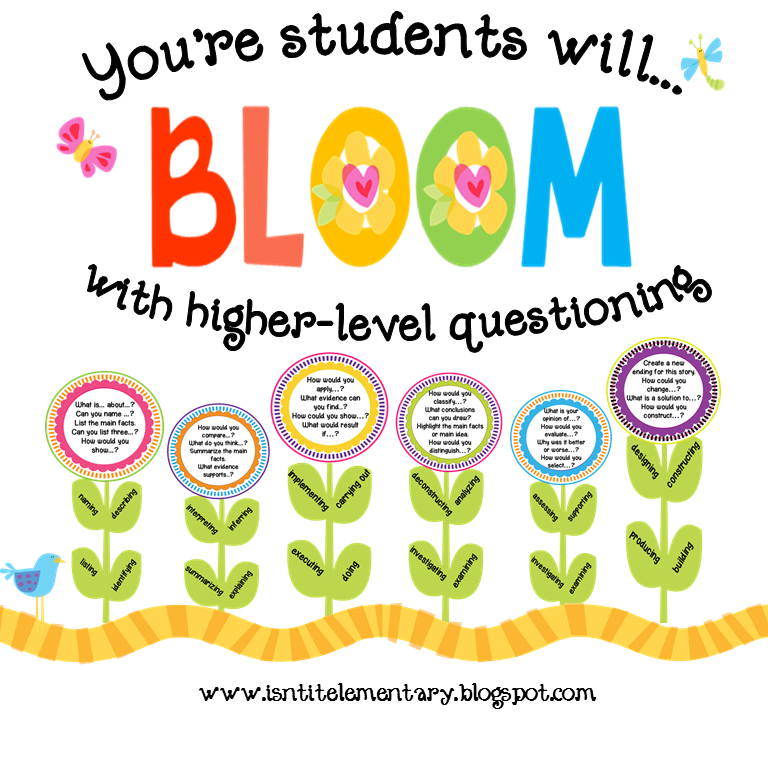
Students BLOOM with Higher-Level Questioning

After receiving some very thoughtful feedback from a customer on Teachers Pay Teachers, I added 3 options for student tools in my Students BLOOM with Higher Level Questioning product.  I have included photos in this post.  

With the implementation of the Common Core Standards, we are always trying “tweak” our lessons to meet the heightened literacy expectations of those standards.  In my own classroom and now as a teacher coach, I always recommend letting the classroom walls talk.  Your classroom walls and your bulletin boards can become interactive graphic organizers of everything that you have taught.  Students should be able to look or walk around and reference all of the research and strategies that you have taught. 

BLOOM and DOK posters with ‘question starters’ always get prime space and always get taught at the beginning of every school year.  Students can take advantage of the accessibility of the posters during instruction, guided practice and independent practice in all content areas.  Of course, our goal is to have students practice asking themselves higher-level questions while they read or close read a text in order to gain a deeper understanding of its meaning.  We also want students to internalize critical thinking skills.  

With that in mind, I spent considerable time today revising two products that I have on Teachers Pay Teachers.  When I create a product, I am always looking for a product that is useful for both teachers and students.  These products are based on the hard work and research of Benjamin Bloom, Norman Webb, Karin Hess, Dennis Carlock, Ben Jones, and John R. Walkup.  I want their research to be accessible to you when you are planning your lessons and delivering those lessons and to your students during the learning process.  
Check these out at www.teacherspayteachers.com/Store/Penny-Lund if you think you can use these in your classroom.   


Saturday, February 28, 2015

Number Bond Centers On Sale!

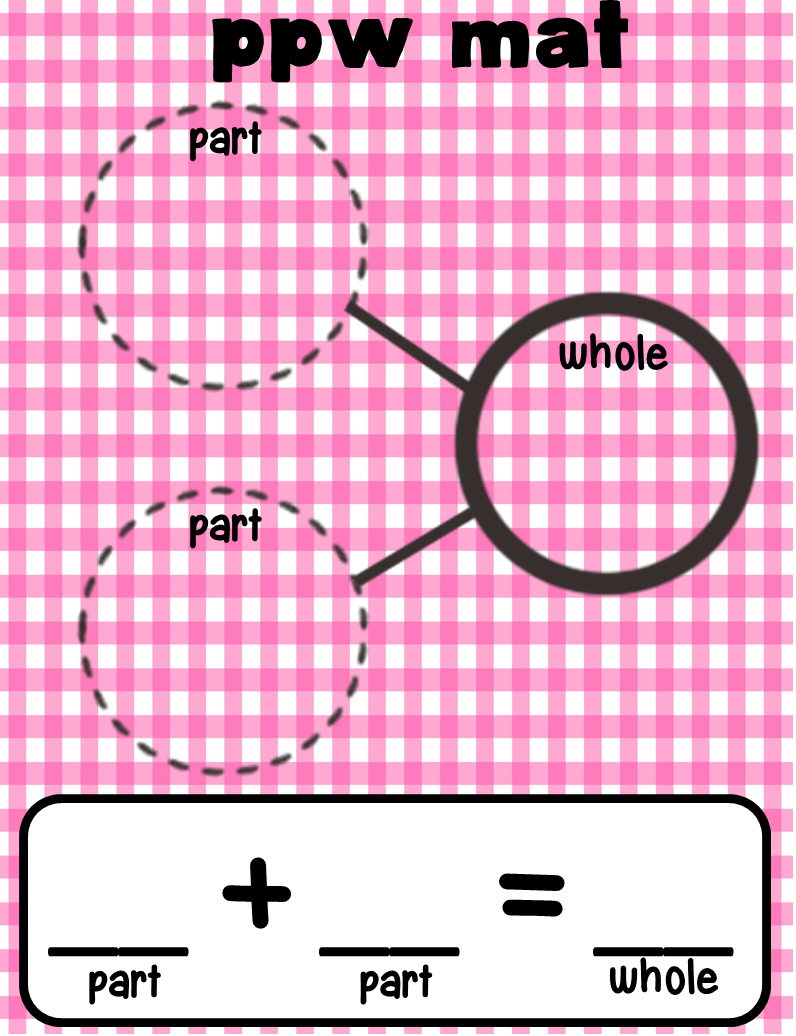
Students need to experience numbers through concrete materials and visual representations before expecting abstract representations.  Number bonds help students to explore the part-part-whole relationship of numbers and are an important foundation for understanding how numbers work. A number bond is a picture of the inverse relationship between addition and subtraction.  If you know the parts, you can put them together (add) to find the whole.  If you know the whole and one of the parts, you take away the part you know (subtract) to find the other part. 
 I have created three number bond products for Teachers Pay Teachers that I am featuring and they will be on sale from March 2-5.  Check them out here.


Tuesday, February 24, 2015

Superhero Owl Behavior Chart

You can find many examples of behavior clip charts on the internet.  When I was teaching, we used to change the color of students cards.  I also used a ticket system.  The behavior clip chart works well because it’s very easy to manage.  All you need to do is create a chart, buy or get some clothespins, and put a student name on each clothespin.  Each day the student’s clothespins usually start in the middle of the chart where it says Ready to Learn.  Students move up or down the chart, during the day, according to their behavior. 

I decided to create this Superhero Owl Behavior Clip Chart for a couple of my friends who teach first grade.  I decided to make my clip chart a little more positive.  In the morning all of your students would find their clip at the top in the Superheroes section.  Take a look below.  During the day students can move down or back up.  If you purchase this chart from Teachers Pay Teachers, you can email me at penny.lund@att.net and I will be glad to customize the chart with your name or custom categories.   I look forward to hearing from you!  Check out the great clipart and great deals from ReviDevi on Etsy.


Sunday, February 15, 2015

Why Teach Academic Vocabulary?

Did you know that vocabulary knowledge in first grade can predict students’ reading comprehension in junior year of college? (Cunningham and Stanovich, 1997)  One of the most consistent findings in reading research is the direct link between the depth of students’ vocabulary knowledge and their reading comprehension.  (Baumann, Kame’emui, 2003; Beck, McKeown, 1983) 

The average middle class first grader enters first grade with a vocabulary of about 2,000 words.  Students in lower socio-economic areas enter first grade with a vocabulary ranging from 10 – 2,000 words!  Research Louisa Moats (2001) refers to this gap in word knowledge between advantaged and disadvantaged children as “word poverty.”  When young students don’t have the vocabulary or word learning strategies struggle to achieve comprehension.  They don’t understand what they read and they typically avoid reading.  “Good readers read more, become better readers and learn more words; poor readers read less, become poorer readers, and learn fewer words.” (Stanovich, 1986)

We can’t afford not to make effective vocabulary instruction one of our highest priorities within our instruction.  In their books on robust vocabulary, Isabel Beck and Margaret McKeown showed that, “ A robust approach to vocabulary instruction was quite effective not only for learning the meanings of words but also for affecting reading comprehension.”  A robust approach to vocabulary involves directly explaining the meanings of words along with thought-provoking, playful and interactive follow up.   Students develop vocabulary through: wide reading of a variety of texts, explicit vocabulary instruction focusing on specific words and their meanings, and multiple exposures to new words in various contexts.
  
I have attached a copy of the instructional sequence for teaching Robust Vocabulary.  I have also attached a  Building Academic Vocabulary poster for you.  You might consider following me. 


Monday, February 2, 2015

Increase Cognitive Rigor in Your Classroom!

 Over the past 4 years, I have worked on the creation of many Common Core documents including curriculum guides, pacing guides, standard checklists and so on.  When you review the language of the standards and look at nouns and the verbs, you will readily notice the close alignment with Bloom’s Revised Taxonomy and Webb’s Depth of Knowledge. 

In 2001, the new version of Bloom’s Taxonomy was released with Bloom’s six major categories changed from nouns to verbs.  The knowledge level was renamed remembering, comprehension was renamed understanding, and synthesis was renamed as creating.  The top two levels switched positions in the revised version. 

Norman Webb from the University of Wisconsin Center for Educational Research generated Depth of Knowledge levels to aid in alignment and analysis of curriculum, instruction and assessments. 
                                   

A year ago, I created and posted free Depth of Knowledge (DOK) posters on Teachers Pay Teachers.  Click here and you can download the free download when my store opens.

My Depth of Knowledge in the Content Areas flipchart is also available free on TPT. 

With the blizzard conditions in the Chicago suburbs, I decided to finish up my revised Depth of Knowledge posters that match my new BLOOM’s posters by color and level of thinking and depth of understanding.
DOK Level 1: Recall/Reproduction matches up with Bloom’s Remembering
DOK Level 2: Skill/Concept matches up with Bloom’s Understanding and Applying
DOK Level 3: Strategic Thinking matches up with Bloom’s Analyzing
DOK Level 4: Extended Thinking matches up with Bloom’s Evaluating and Creating

I posted the product on TPT and the product includes the BLOOM’s and DOK posters, a BLOOM’s bookmark and a Rigorous Questioning Tool that I created.  Like the Cognitive Rigor Matrix, the Rigorous Questioning Tool aligns Bloom’s Taxonomy and Webb’s Depth of Knowledge.  The difference is my tool focuses on the question stems of both documents and the Cognitive Rigor Matrix focuses on the levels of thinking and understanding.  To better understand the content being taught, students need to think criticially and to ask and answer higher levels of questioning.  By asking higher-level questions and participating in collaborative discussion, students deepen their knowledge and create connection to what is being taught.   I thought my Rigorous Questioning Tool would make a great addition to your students’ toolboxes.


 In addition to Bloom’s levels of questioning, students can benefit by becoming familiar with Costa’s  Three Story Intellect.  It’s very similar to both Bloom’s levels of questioning.  In the basement, students gather information.  On the first floor, students process information.  In the penthouse, students apply information.  You got it! I created a flapbook for the Costa’s Three Story Intellect and posted it on TPT.   I love using flapbooks in student journals and interactive student notebook.  Flapbooks are great for taking notes and formative assessments.


I also decided to revise my, “BLOOM with Higher Level Questioning”, from TPT.  The revised product now includes a new updated look and a bookmark.  Check out the photos below or on Pinterest. 


Finally, I have attempted to make my first subway poster on the topic of Rigor, BLOOM and DOK.
Check out the cute clipart from Hoot and Crow.  Grab it here.


Monday, December 29, 2014

Close Reading for Teachers: Choice Words

I was working on a presentation focusing on the CCSS six shifts for instruction in English Language Arts yesterday, when I pulled out Peter Johnson's book, Choice Words: How Our Language Affects Children's Learning from one of my bookshelves.  The proverb, "Better Late Than Never," certainly applies to the reading and digesting of this book.  It is a short read but it is so profound and thought-provoking that I found myself going back to reread sections and think about them.  I only used post-it notes to write down my thoughts because it seemed sacrilegious to underline or highlight anything in this book.  This is definitely a book that every teacher would not only want to read but should read if they are interested in "creating intellectual environments that produce not only technically competent students, but also caring, secure, actively literate human beings." (taken from the back cover of the book, Choice Words)

"If we have learned anything from Vgotsky [1978], it is that 'children grow into the intellectual life around them'."  What if our most powerful teaching tool is our language?  "Throughout his book, Choice Words, Peter Johnson provides examples of apparently ordinary words, phrases and uses of language that are pivotal in the orchestration of the classroom."   

In Chapter Two: Noticing and Naming, Johnston demonstrates the power of ordinary words and phrases.  I loved the phrase, "Write down a line you wish you had written",  that asks children to turn their attention to the qualities of words while it implies that obviously they will want to use wonderful words to be authors themselves.  I wish I had written the line, "What if the children in our classes learned that what they notice matters, and that is is a valued topic of conversation?"  

As I read and reread the first 4 chapters, I realized that I was really doing a close reading with a first read, a second read and so on...   I was noticing the key understandings, things that surprised me, things that I was still wondering about and key vocabulary.  What a great book for us to practice and apply close reading skills.

Buy yourself a gift this holiday season that will have a lasting affect on your teaching.  You can do no better than to purchase and cherish this book.  


Monday, December 8, 2014

Freebie Day Potpourri!

I have spent the entire weekend into today, trying to finally complete some of my projects that have been sitting incomplete for over 6 months!  My work as a teacher coach has taken precedence over my personal work.  I have decided to celebrate and post the three free products that I posted today. While you're at my TPT store for these freebies, check out my other products.  I'd love to hear your feedback.  Thanks for checking out my blog.

My first free product is a set of VI COWS: 6 Traits Posters. The VI COWS stands for voice, ideas, conventions, organization, excellent word choice and sentence fluency.  I absolutely love the cows with the red hats from Scrappin Doodles. Just click the link below for the complete file on TPT.  Sorry about the terrible photo.  It's raining and icing up in the suburbs of Chicago!

                                                             VI COWS posters on TPT

My second free product is a 5 Inch Voices Banner for use with the implementation of Daily 5 and the fostering of literacy independence and the habits of mind necessary for small group work.  I have included a photo but just click on the link below for the complete free file on TPT. Credit for the cover clipart goes to DJInkers.


                                                  VOICE LEVELS POSTERS from TPT


My third free product are posters of the three reading voices: the reading voice, the thinking voice, and the distracting voice.  I attended a workshop from smekenseducation.com and I was reminded of the three voices that students hear while they are reading and using metacognition.  I went searching and found a document by the Reading Lady, Ginger Weisnek, that she adapted in 2005.  It's a great introductory unit on Metacognition.  I have attached both documents below.  Click on the titles and follow the links.  Credit for the clipart for the Reading Voices Posters goes to Melonheadz Illustrations and Creative Clips.  Check out their work on TPT and Etsy.

                                           METACOGNITION, AN INTRODUCTORY UNIT

                                                  READING VOICES POSTERS 

Sunday, October 5, 2014

How to Make a Portable Word Wall


If you want to make a portable word wall 
in your classroom...

1. See a portable word wall in a 
colleague's classroom.
2. Research the portable word wall and 
see an example of one on Pinterest.  All word cards are sorted by the letter of the alphabet and stored on a one inch book ring.  Each book ring is hung on its own (removable) hook in alphabetical order across the wall under the chalk ledge.  
3. Go to www.djinkers.com and purchase alphabet border and printer pages.  Create the ABC covers for each book ring.  Find an amazing site with free flashcards, www.uniqueteachingresources.com
4. Heidi McDonald has created the site, Unique Teaching Resources and it is a goldmine.  Heidi has grouped the Fry Words in lists of 100 words.  Each set includes the list, a student profile list, weekly word lists and color-coded flashcards.  Run the flashcards on cardstock and cut them out.  Three-hole punch the cards and sort the cards according to the letters of the alphabet.  Put all of the letters cards on their correct letter card ring.  Hang the 26 removable hooks on the wall and hang the portable letter card rings in alphabetical order on the hooks!  

I have attached a copy of the ABC cover cards, a full-size word work journal and a smaller -version of the word work journal.  Get your copy HERE.  


Tuesday, February 4, 2014

Looking for Rigor and DOK Resources?

If you are looking for Rigor and DOK resources, look no more.  I have collected a number of resources on Bloom's taxonomy and Webbs Depth of Knowledge but I have put my top 25 picks in one document for you to peruse.  I hope you find it helpful.  Also, check out my free DOK posters right on this blog!

Download Top 25 Picks Here!

I just reloaded this as a Word document.  
I checked all the hyperlinks again. 
Email me if you have any trouble.
penny.lund@att.net

Thursday, January 2, 2014

Planning Your Own Differentiated Instruction Workshop!


I recently created and facilitated a worked on Differentiated Instruction That Works. The hardest part about planning for professional development is creating the framework for the presentation.  Once you have the framework, you can do your research and synthesize all the materials into the framework.  I created this workshop on Differentiated Instruction for the administrators and lead teachers from each building in one of the districts where I provide professional development.  Also this professional development is different from any workshop that I have ever facilitated because every document, video, or webinar is hyperlinked in the agenda for the participants.  Participants had the freedom within each session to view the webinars and the view and/or read the attached documents.  Each session ended with embedded activities for reflecting on the takeaways from within each session.  In addition, each session ended with participants creating goals and action steps in a schoolwide action plan to ensure the implementation of differentiated instruction.  I am sharing the hyperlinked agenda, including copies of all of the posters.  The DI Message Frames are available FREE and this workshop is available for purchase at my TPT store.  So, no matter if you are going to facilitate a workshop on differentiated instruction, or are looking for resources for your classroom or improving professional practice, this is a great resource on differentiated instruction all in one place!

Resources:  How to Differentiate in a Mixed-Ability Classroom, Carol Tomlinson, 2001
 Leading and Managing a Differentiated Classroom, Carol Ann Tomlinson and Marcia B. Imbeau, 2010                                     
 Step 1:  I created the framework. The presentation is divided into four sessions:
1.       Getting Started With Differentiated Instruction
2.       Managing Differentiated Instruction
3.       Low-Prep Strategies
4.       Community of Practice School Action Plan

Step 2: I created a two-column agenda that is organized into sections for each of the sessions.  Each session had an opening activity and a closing activity for reflection.  Each session was part of creating a schoolwide action plan.  As I listed each item on the agenda in column one, I attached the appropriate document, video or webinar hyperlink.  Right before the workshop, I emailed the hyperlinked agenda to each of the participants.  Each participant then had control over what they took away from each session.  I just facilitated the workshop as we as teachers facilitate learning in our classrooms. 

Step 3:  I created all of the posters and workshop materials including a handout.  The posters include: Belief Statements about DI, DI Message Frames, Hot Spots in a Differentiated Classroom. I also created a sample Choice Board and a sample Learning Profile Pre-Assessment (pictured below)

Sample Learning Profile Pre-Assessment (Opening Activity)


Monday, December 30, 2013

Webb's Depth of Knowledge & DOK Posters FREEBIE!

Everybody is talking about RIGOR or asking, "What is rigor?"  If you do any research on rigor, you will find that rigor does not mean difficulty.  Instead rigor means the level of mental processing that must occur to answer a question, perform a task or generate a product.   Two widely used measures of rigor are Bloom's Taxonomy and Webb's Depth of Knowledge Levels.  Both measures of rigor go from the simple to the complex. Karen Hess' Cognitive Rigor Matrix integrates these models as a strategy for analyzing the level of teacher lessons and assessments.  Bloom's verbs indicate the level of performance or the level of questioning.  Webb's Depth of Knowledge focuses on the complexity of standards in order to successfully complete an assessment or a task.  The outcome (product) is the focus of the depth of understanding.  

In my district, we have been using Karen Hess' Cognitive Rigor Matrix to map out our learning events in our UbD units  This matrix allows you to map out your lessons and assessments to ensure a balance at all levels.  Certainly there is a place for recall and reproduction or routine thinking, but this matrix can be used for "tweaking" some of our lessons to make them more rigorous.  When you unpack the Common Core Standards, look at the verbs and align the standard with the level of Bloom's taxonomy.  Then check out what follows the verb to indicate the level of understanding.  What comes after the verb is more important than the verb itself.  For example, 
                     DOK 1 Describe three characteristics of metamorphic rocks. 
                     DOK 2 Describe the difference between metamorphic and igneous rocks.
                     DOK 3 Describe a model you might use to represent the relationships 
                                  that exist within the rock cycle. 


Online, you can easily find copies of the Cognitive Rigor Matrix for ELA, Math, Science and Social Studies.  You can also find the Bloom's Posters created by Wake County Public Schools System Academically Gifted Program. 


 I am attaching a link to my free flipchart on DOK in the Content areas on TPT.


You can also download my free Depth of Knowledge  posters for your classroom.