Showing posts with label Bloom's taxonomy. Show all posts

Monday, February 2, 2015

Increase Cognitive Rigor in Your Classroom!

 Over the past 4 years, I have worked on the creation of many Common Core documents including curriculum guides, pacing guides, standard checklists and so on.  When you review the language of the standards and look at nouns and the verbs, you will readily notice the close alignment with Bloom’s Revised Taxonomy and Webb’s Depth of Knowledge. 

In 2001, the new version of Bloom’s Taxonomy was released with Bloom’s six major categories changed from nouns to verbs.  The knowledge level was renamed remembering, comprehension was renamed understanding, and synthesis was renamed as creating.  The top two levels switched positions in the revised version. 

Norman Webb from the University of Wisconsin Center for Educational Research generated Depth of Knowledge levels to aid in alignment and analysis of curriculum, instruction and assessments. 
                                   

A year ago, I created and posted free Depth of Knowledge (DOK) posters on Teachers Pay Teachers.  Click here and you can download the free download when my store opens.

My Depth of Knowledge in the Content Areas flipchart is also available free on TPT. 

With the blizzard conditions in the Chicago suburbs, I decided to finish up my revised Depth of Knowledge posters that match my new BLOOM’s posters by color and level of thinking and depth of understanding.
DOK Level 1: Recall/Reproduction matches up with Bloom’s Remembering
DOK Level 2: Skill/Concept matches up with Bloom’s Understanding and Applying
DOK Level 3: Strategic Thinking matches up with Bloom’s Analyzing
DOK Level 4: Extended Thinking matches up with Bloom’s Evaluating and Creating

I posted the product on TPT and the product includes the BLOOM’s and DOK posters, a BLOOM’s bookmark and a Rigorous Questioning Tool that I created.  Like the Cognitive Rigor Matrix, the Rigorous Questioning Tool aligns Bloom’s Taxonomy and Webb’s Depth of Knowledge.  The difference is my tool focuses on the question stems of both documents and the Cognitive Rigor Matrix focuses on the levels of thinking and understanding.  To better understand the content being taught, students need to think criticially and to ask and answer higher levels of questioning.  By asking higher-level questions and participating in collaborative discussion, students deepen their knowledge and create connection to what is being taught.   I thought my Rigorous Questioning Tool would make a great addition to your students’ toolboxes.


 In addition to Bloom’s levels of questioning, students can benefit by becoming familiar with Costa’s  Three Story Intellect.  It’s very similar to both Bloom’s levels of questioning.  In the basement, students gather information.  On the first floor, students process information.  In the penthouse, students apply information.  You got it! I created a flapbook for the Costa’s Three Story Intellect and posted it on TPT.   I love using flapbooks in student journals and interactive student notebook.  Flapbooks are great for taking notes and formative assessments.


I also decided to revise my, “BLOOM with Higher Level Questioning”, from TPT.  The revised product now includes a new updated look and a bookmark.  Check out the photos below or on Pinterest. 
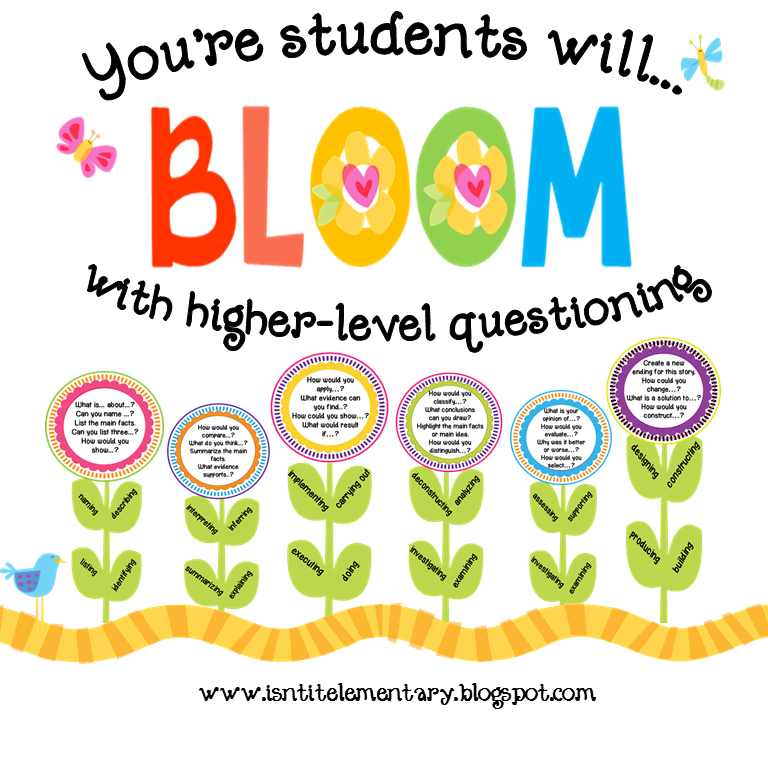


Finally, I have attempted to make my first subway poster on the topic of Rigor, BLOOM and DOK.
Check out the cute clipart from Hoot and Crow.  Grab it here.


Tuesday, February 4, 2014

Looking for Rigor and DOK Resources?

If you are looking for Rigor and DOK resources, look no more.  I have collected a number of resources on Bloom's taxonomy and Webbs Depth of Knowledge but I have put my top 25 picks in one document for you to peruse.  I hope you find it helpful.  Also, check out my free DOK posters right on this blog!

Download Top 25 Picks Here!

I just reloaded this as a Word document.  
I checked all the hyperlinks again. 
Email me if you have any trouble.
penny.lund@att.net

Monday, December 30, 2013

Webb's Depth of Knowledge & DOK Posters FREEBIE!

Everybody is talking about RIGOR or asking, "What is rigor?"  If you do any research on rigor, you will find that rigor does not mean difficulty.  Instead rigor means the level of mental processing that must occur to answer a question, perform a task or generate a product.   Two widely used measures of rigor are Bloom's Taxonomy and Webb's Depth of Knowledge Levels.  Both measures of rigor go from the simple to the complex. Karen Hess' Cognitive Rigor Matrix integrates these models as a strategy for analyzing the level of teacher lessons and assessments.  Bloom's verbs indicate the level of performance or the level of questioning.  Webb's Depth of Knowledge focuses on the complexity of standards in order to successfully complete an assessment or a task.  The outcome (product) is the focus of the depth of understanding.  

In my district, we have been using Karen Hess' Cognitive Rigor Matrix to map out our learning events in our UbD units  This matrix allows you to map out your lessons and assessments to ensure a balance at all levels.  Certainly there is a place for recall and reproduction or routine thinking, but this matrix can be used for "tweaking" some of our lessons to make them more rigorous.  When you unpack the Common Core Standards, look at the verbs and align the standard with the level of Bloom's taxonomy.  Then check out what follows the verb to indicate the level of understanding.  What comes after the verb is more important than the verb itself.  For example, 
                     DOK 1 Describe three characteristics of metamorphic rocks. 
                     DOK 2 Describe the difference between metamorphic and igneous rocks.
                     DOK 3 Describe a model you might use to represent the relationships 
                                  that exist within the rock cycle. 


Online, you can easily find copies of the Cognitive Rigor Matrix for ELA, Math, Science and Social Studies.  You can also find the Bloom's Posters created by Wake County Public Schools System Academically Gifted Program. 


 I am attaching a link to my free flipchart on DOK in the Content areas on TPT.


You can also download my free Depth of Knowledge  posters for your classroom.  

Saturday, November 2, 2013

What is Rigor? FREEBIE DOK Posters!

Everyone is talking about RIGOR.  The Common Core Standards call for a more rigorous curriculum, instructon and assessment.  Rigor is the kind and level of thinking required of students to successfully engage with and solve a task.  Rigor is not about difficulty, it's about complexity of understanding. 

What does rigor look like in a classroom?  Two widely accepted measures of cognitive rigor are Bloom's Taxonomy and Webb's Depth of Knowledge Levels.  Bloom's Taxonomy focuses on the verbs and indicate the level of performance or the level of higher-level questions.   Depth of Knowledge focuses of complexity of content standards to successfully complete an assessment or a task.  When you unpack the standards, first look at the verb and align it with Bloom's levels for the level of performance.  Then look beyond the verb to determine the level of understanding required to meet the standard.  

Karen Hess created a Cognitive Rigor Matrix that integrates Bloom's Taxonomy with Webb's Depth of Knowledge for analyzing teacher lesson planning and assessments.  In my district, we have been "mapping" out the learning events in our UbD units to ensure a balance of lessons and assessments across all levels from simple to complex.  Teachers are seeing that they can "tweak" some of their lessons and assessments to make them more rigorous.  For example, 

DOK 1 Describe three characteristics of metamorphic rocks.
DOK 2 Describe the difference between metamorphic and igneous rocks.
DOK 3 Describe a model you might use to represent the relationships that exist in the rock cycle  

All three tasks begin with the word describe but each task is at a different depth of knowledge.  Check out what comes after the verb!  What comes after the verb is more important than the verb itself.  

Karen Hess has a Cognitive Rigor Matrix for ELA, Math/Science, Social Studies and the Arts. and they can easily be found on the internet.  You can also find beautiful Bloom's Taxonomy posters for the elementary grades from Wake County Public School System.  

Grab my free Depth of Knowledge DOK flipchart on TPT:

I am also attaching Depth of Knowledge DOK posters that I created today.

Enjoy!

Monday, March 4, 2013

Have a Ball with BLOOM'S Taxonomy!


I'm off school today so I'm trying to catch up on everything.  Consequently, I have posted two BLOOM with higher-level thinking products on TPT today.  The first one is BLOOM with Questioning blooms to hang up on an English Language Arts focus wall for reference.  In the photo below, notice the stems with the key words and the flower pots.  The stems are an editable resource and along with the pots are available free on www.sparklebox.co.uk.  If you aren't acquainted with Sparklebox, everything is free.  All you need is lots of white cardstock and access to a colored printer.  It's like free, one-stop shopping!

The second is a two for one product.  In Part 1, students construct a Bloom's Ball as a tool for creating higher-level questions.  I have used the Bloom's Ball many times with kids as I have modeled this activity in classrooms.  Part 2 is a performance task where students customize the 12 panels of the Bloom's Ball in response to reading a literary or non-fiction book.  Directions for this task are included and this performance task can be completed individually or as a group project.  I'd love to hear from you if you try these resources.
Completed Bloom's Ball
Putting the Panels Together