Showing posts with label rigorous questioning tool. Show all posts

Sunday, September 20, 2015

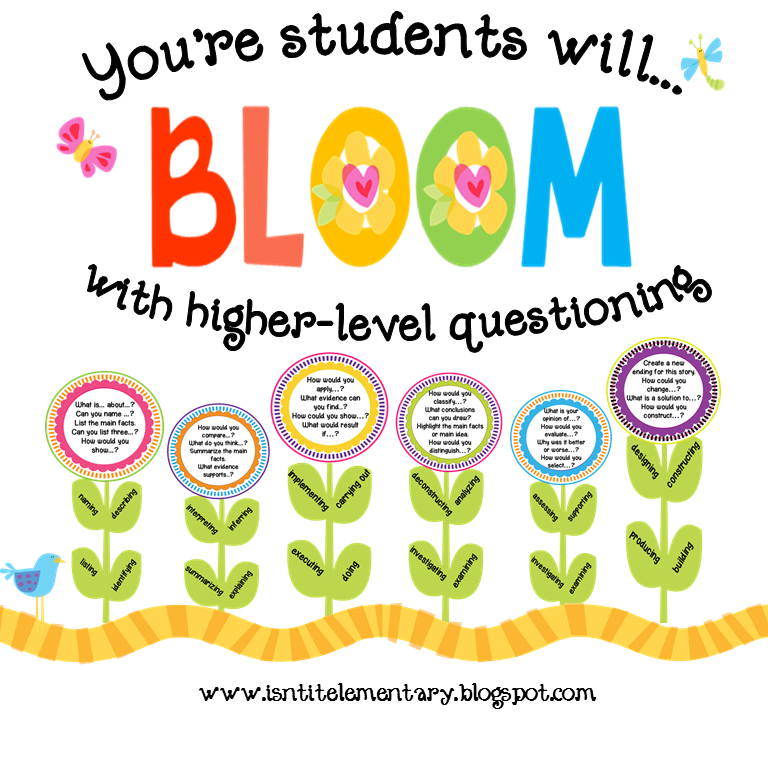
Students BLOOM with Higher-Level Questioning

After receiving some very thoughtful feedback from a customer on Teachers Pay Teachers, I added 3 options for student tools in my Students BLOOM with Higher Level Questioning product.  I have included photos in this post.  

With the implementation of the Common Core Standards, we are always trying “tweak” our lessons to meet the heightened literacy expectations of those standards.  In my own classroom and now as a teacher coach, I always recommend letting the classroom walls talk.  Your classroom walls and your bulletin boards can become interactive graphic organizers of everything that you have taught.  Students should be able to look or walk around and reference all of the research and strategies that you have taught. 

BLOOM and DOK posters with ‘question starters’ always get prime space and always get taught at the beginning of every school year.  Students can take advantage of the accessibility of the posters during instruction, guided practice and independent practice in all content areas.  Of course, our goal is to have students practice asking themselves higher-level questions while they read or close read a text in order to gain a deeper understanding of its meaning.  We also want students to internalize critical thinking skills.  

With that in mind, I spent considerable time today revising two products that I have on Teachers Pay Teachers.  When I create a product, I am always looking for a product that is useful for both teachers and students.  These products are based on the hard work and research of Benjamin Bloom, Norman Webb, Karin Hess, Dennis Carlock, Ben Jones, and John R. Walkup.  I want their research to be accessible to you when you are planning your lessons and delivering those lessons and to your students during the learning process.  
Check these out at www.teacherspayteachers.com/Store/Penny-Lund if you think you can use these in your classroom.   


Monday, February 2, 2015

Increase Cognitive Rigor in Your Classroom!

 Over the past 4 years, I have worked on the creation of many Common Core documents including curriculum guides, pacing guides, standard checklists and so on.  When you review the language of the standards and look at nouns and the verbs, you will readily notice the close alignment with Bloom’s Revised Taxonomy and Webb’s Depth of Knowledge. 

In 2001, the new version of Bloom’s Taxonomy was released with Bloom’s six major categories changed from nouns to verbs.  The knowledge level was renamed remembering, comprehension was renamed understanding, and synthesis was renamed as creating.  The top two levels switched positions in the revised version. 

Norman Webb from the University of Wisconsin Center for Educational Research generated Depth of Knowledge levels to aid in alignment and analysis of curriculum, instruction and assessments. 
                                   

A year ago, I created and posted free Depth of Knowledge (DOK) posters on Teachers Pay Teachers.  Click here and you can download the free download when my store opens.

My Depth of Knowledge in the Content Areas flipchart is also available free on TPT. 

With the blizzard conditions in the Chicago suburbs, I decided to finish up my revised Depth of Knowledge posters that match my new BLOOM’s posters by color and level of thinking and depth of understanding.
DOK Level 1: Recall/Reproduction matches up with Bloom’s Remembering
DOK Level 2: Skill/Concept matches up with Bloom’s Understanding and Applying
DOK Level 3: Strategic Thinking matches up with Bloom’s Analyzing
DOK Level 4: Extended Thinking matches up with Bloom’s Evaluating and Creating

I posted the product on TPT and the product includes the BLOOM’s and DOK posters, a BLOOM’s bookmark and a Rigorous Questioning Tool that I created.  Like the Cognitive Rigor Matrix, the Rigorous Questioning Tool aligns Bloom’s Taxonomy and Webb’s Depth of Knowledge.  The difference is my tool focuses on the question stems of both documents and the Cognitive Rigor Matrix focuses on the levels of thinking and understanding.  To better understand the content being taught, students need to think criticially and to ask and answer higher levels of questioning.  By asking higher-level questions and participating in collaborative discussion, students deepen their knowledge and create connection to what is being taught.   I thought my Rigorous Questioning Tool would make a great addition to your students’ toolboxes.


 In addition to Bloom’s levels of questioning, students can benefit by becoming familiar with Costa’s  Three Story Intellect.  It’s very similar to both Bloom’s levels of questioning.  In the basement, students gather information.  On the first floor, students process information.  In the penthouse, students apply information.  You got it! I created a flapbook for the Costa’s Three Story Intellect and posted it on TPT.   I love using flapbooks in student journals and interactive student notebook.  Flapbooks are great for taking notes and formative assessments.


I also decided to revise my, “BLOOM with Higher Level Questioning”, from TPT.  The revised product now includes a new updated look and a bookmark.  Check out the photos below or on Pinterest. 


Finally, I have attempted to make my first subway poster on the topic of Rigor, BLOOM and DOK.
Check out the cute clipart from Hoot and Crow.  Grab it here.