Tuesday, February 24, 2015

Superhero Owl Behavior Chart

You can find many examples of behavior clip charts on the internet.  When I was teaching, we used to change the color of students cards.  I also used a ticket system.  The behavior clip chart works well because it’s very easy to manage.  All you need to do is create a chart, buy or get some clothespins, and put a student name on each clothespin.  Each day the student’s clothespins usually start in the middle of the chart where it says Ready to Learn.  Students move up or down the chart, during the day, according to their behavior. 

I decided to create this Superhero Owl Behavior Clip Chart for a couple of my friends who teach first grade.  I decided to make my clip chart a little more positive.  In the morning all of your students would find their clip at the top in the Superheroes section.  Take a look below.  During the day students can move down or back up.  If you purchase this chart from Teachers Pay Teachers, you can email me at penny.lund@att.net and I will be glad to customize the chart with your name or custom categories.   I look forward to hearing from you!  Check out the great clipart and great deals from ReviDevi on Etsy.


Sunday, February 15, 2015

Why Teach Academic Vocabulary?

Did you know that vocabulary knowledge in first grade can predict students’ reading comprehension in junior year of college? (Cunningham and Stanovich, 1997)  One of the most consistent findings in reading research is the direct link between the depth of students’ vocabulary knowledge and their reading comprehension.  (Baumann, Kame’emui, 2003; Beck, McKeown, 1983) 

The average middle class first grader enters first grade with a vocabulary of about 2,000 words.  Students in lower socio-economic areas enter first grade with a vocabulary ranging from 10 – 2,000 words!  Research Louisa Moats (2001) refers to this gap in word knowledge between advantaged and disadvantaged children as “word poverty.”  When young students don’t have the vocabulary or word learning strategies struggle to achieve comprehension.  They don’t understand what they read and they typically avoid reading.  “Good readers read more, become better readers and learn more words; poor readers read less, become poorer readers, and learn fewer words.” (Stanovich, 1986)

We can’t afford not to make effective vocabulary instruction one of our highest priorities within our instruction.  In their books on robust vocabulary, Isabel Beck and Margaret McKeown showed that, “ A robust approach to vocabulary instruction was quite effective not only for learning the meanings of words but also for affecting reading comprehension.”  A robust approach to vocabulary involves directly explaining the meanings of words along with thought-provoking, playful and interactive follow up.   Students develop vocabulary through: wide reading of a variety of texts, explicit vocabulary instruction focusing on specific words and their meanings, and multiple exposures to new words in various contexts.
  
I have attached a copy of the instructional sequence for teaching Robust Vocabulary.  I have also attached a  Building Academic Vocabulary poster for you.  You might consider following me. 


Monday, February 2, 2015

Increase Cognitive Rigor in Your Classroom!

 Over the past 4 years, I have worked on the creation of many Common Core documents including curriculum guides, pacing guides, standard checklists and so on.  When you review the language of the standards and look at nouns and the verbs, you will readily notice the close alignment with Bloom’s Revised Taxonomy and Webb’s Depth of Knowledge. 

In 2001, the new version of Bloom’s Taxonomy was released with Bloom’s six major categories changed from nouns to verbs.  The knowledge level was renamed remembering, comprehension was renamed understanding, and synthesis was renamed as creating.  The top two levels switched positions in the revised version. 

Norman Webb from the University of Wisconsin Center for Educational Research generated Depth of Knowledge levels to aid in alignment and analysis of curriculum, instruction and assessments. 
                                   

A year ago, I created and posted free Depth of Knowledge (DOK) posters on Teachers Pay Teachers.  Click here and you can download the free download when my store opens.

My Depth of Knowledge in the Content Areas flipchart is also available free on TPT. 

With the blizzard conditions in the Chicago suburbs, I decided to finish up my revised Depth of Knowledge posters that match my new BLOOM’s posters by color and level of thinking and depth of understanding.
DOK Level 1: Recall/Reproduction matches up with Bloom’s Remembering
DOK Level 2: Skill/Concept matches up with Bloom’s Understanding and Applying
DOK Level 3: Strategic Thinking matches up with Bloom’s Analyzing
DOK Level 4: Extended Thinking matches up with Bloom’s Evaluating and Creating

I posted the product on TPT and the product includes the BLOOM’s and DOK posters, a BLOOM’s bookmark and a Rigorous Questioning Tool that I created.  Like the Cognitive Rigor Matrix, the Rigorous Questioning Tool aligns Bloom’s Taxonomy and Webb’s Depth of Knowledge.  The difference is my tool focuses on the question stems of both documents and the Cognitive Rigor Matrix focuses on the levels of thinking and understanding.  To better understand the content being taught, students need to think criticially and to ask and answer higher levels of questioning.  By asking higher-level questions and participating in collaborative discussion, students deepen their knowledge and create connection to what is being taught.   I thought my Rigorous Questioning Tool would make a great addition to your students’ toolboxes.


 In addition to Bloom’s levels of questioning, students can benefit by becoming familiar with Costa’s  Three Story Intellect.  It’s very similar to both Bloom’s levels of questioning.  In the basement, students gather information.  On the first floor, students process information.  In the penthouse, students apply information.  You got it! I created a flapbook for the Costa’s Three Story Intellect and posted it on TPT.   I love using flapbooks in student journals and interactive student notebook.  Flapbooks are great for taking notes and formative assessments.


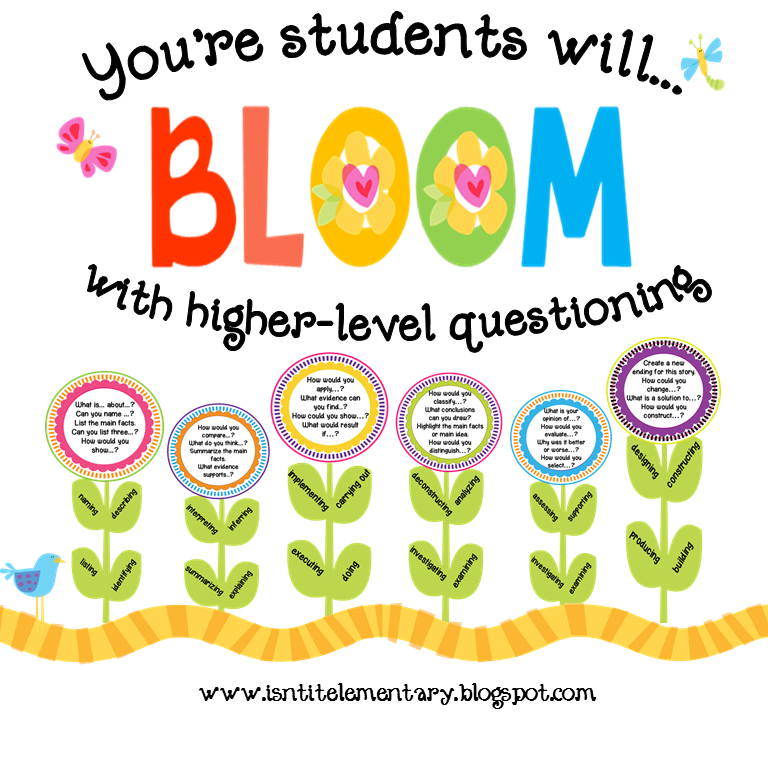
I also decided to revise my, “BLOOM with Higher Level Questioning”, from TPT.  The revised product now includes a new updated look and a bookmark.  Check out the photos below or on Pinterest. 


Finally, I have attempted to make my first subway poster on the topic of Rigor, BLOOM and DOK.
Check out the cute clipart from Hoot and Crow.  Grab it here.


Monday, December 29, 2014

Close Reading for Teachers: Choice Words

I was working on a presentation focusing on the CCSS six shifts for instruction in English Language Arts yesterday, when I pulled out Peter Johnson's book, Choice Words: How Our Language Affects Children's Learning from one of my bookshelves.  The proverb, "Better Late Than Never," certainly applies to the reading and digesting of this book.  It is a short read but it is so profound and thought-provoking that I found myself going back to reread sections and think about them.  I only used post-it notes to write down my thoughts because it seemed sacrilegious to underline or highlight anything in this book.  This is definitely a book that every teacher would not only want to read but should read if they are interested in "creating intellectual environments that produce not only technically competent students, but also caring, secure, actively literate human beings." (taken from the back cover of the book, Choice Words)

"If we have learned anything from Vgotsky [1978], it is that 'children grow into the intellectual life around them'."  What if our most powerful teaching tool is our language?  "Throughout his book, Choice Words, Peter Johnson provides examples of apparently ordinary words, phrases and uses of language that are pivotal in the orchestration of the classroom."   

In Chapter Two: Noticing and Naming, Johnston demonstrates the power of ordinary words and phrases.  I loved the phrase, "Write down a line you wish you had written",  that asks children to turn their attention to the qualities of words while it implies that obviously they will want to use wonderful words to be authors themselves.  I wish I had written the line, "What if the children in our classes learned that what they notice matters, and that is is a valued topic of conversation?"  

As I read and reread the first 4 chapters, I realized that I was really doing a close reading with a first read, a second read and so on...   I was noticing the key understandings, things that surprised me, things that I was still wondering about and key vocabulary.  What a great book for us to practice and apply close reading skills.

Buy yourself a gift this holiday season that will have a lasting affect on your teaching.  You can do no better than to purchase and cherish this book.  


Monday, December 8, 2014

Freebie Day Potpourri!

I have spent the entire weekend into today, trying to finally complete some of my projects that have been sitting incomplete for over 6 months!  My work as a teacher coach has taken precedence over my personal work.  I have decided to celebrate and post the three free products that I posted today. While you're at my TPT store for these freebies, check out my other products.  I'd love to hear your feedback.  Thanks for checking out my blog.

My first free product is a set of VI COWS: 6 Traits Posters. The VI COWS stands for voice, ideas, conventions, organization, excellent word choice and sentence fluency.  I absolutely love the cows with the red hats from Scrappin Doodles. Just click the link below for the complete file on TPT.  Sorry about the terrible photo.  It's raining and icing up in the suburbs of Chicago!

                                                             VI COWS posters on TPT

My second free product is a 5 Inch Voices Banner for use with the implementation of Daily 5 and the fostering of literacy independence and the habits of mind necessary for small group work.  I have included a photo but just click on the link below for the complete free file on TPT. Credit for the cover clipart goes to DJInkers.


                                                  VOICE LEVELS POSTERS from TPT


My third free product are posters of the three reading voices: the reading voice, the thinking voice, and the distracting voice.  I attended a workshop from smekenseducation.com and I was reminded of the three voices that students hear while they are reading and using metacognition.  I went searching and found a document by the Reading Lady, Ginger Weisnek, that she adapted in 2005.  It's a great introductory unit on Metacognition.  I have attached both documents below.  Click on the titles and follow the links.  Credit for the clipart for the Reading Voices Posters goes to Melonheadz Illustrations and Creative Clips.  Check out their work on TPT and Etsy.

                                           METACOGNITION, AN INTRODUCTORY UNIT

                                                  READING VOICES POSTERS 

Sunday, October 5, 2014

How to Make a Portable Word Wall


If you want to make a portable word wall 
in your classroom...

1. See a portable word wall in a 
colleague's classroom.
2. Research the portable word wall and 
see an example of one on Pinterest.  All word cards are sorted by the letter of the alphabet and stored on a one inch book ring.  Each book ring is hung on its own (removable) hook in alphabetical order across the wall under the chalk ledge.  
3. Go to www.djinkers.com and purchase alphabet border and printer pages.  Create the ABC covers for each book ring.  Find an amazing site with free flashcards, www.uniqueteachingresources.com
4. Heidi McDonald has created the site, Unique Teaching Resources and it is a goldmine.  Heidi has grouped the Fry Words in lists of 100 words.  Each set includes the list, a student profile list, weekly word lists and color-coded flashcards.  Run the flashcards on cardstock and cut them out.  Three-hole punch the cards and sort the cards according to the letters of the alphabet.  Put all of the letters cards on their correct letter card ring.  Hang the 26 removable hooks on the wall and hang the portable letter card rings in alphabetical order on the hooks!  

I have attached a copy of the ABC cover cards, a full-size word work journal and a smaller -version of the word work journal.  Get your copy HERE.  


Tuesday, February 4, 2014

Looking for Rigor and DOK Resources?

If you are looking for Rigor and DOK resources, look no more.  I have collected a number of resources on Bloom's taxonomy and Webbs Depth of Knowledge but I have put my top 25 picks in one document for you to peruse.  I hope you find it helpful.  Also, check out my free DOK posters right on this blog!

Download Top 25 Picks Here!

I just reloaded this as a Word document.  
I checked all the hyperlinks again. 
Email me if you have any trouble.
penny.lund@att.net